PPRLab | UFRGS - HCPA
Pesquisa como agente de mudança
Ação Translacional: Divulgação Continuada de Resultados, estratégias de enfrentamento e recuperação Adaptadas à População em "tempo real".
O Laboratório investiga como indivíduos, vínculos, grupos e instituições respondem ao estresse e ao trauma, com foco nos processos que favorecem recuperação, plasticidade e funcionalidade em contraponto ao que matém levam sofrimento e leva à perda funcional.
As diferentes linhas de pesquisa, amadureceram ao longo do tempo, integrando a clínica, o social, a psicoterapia e a neurobiologia, com foco nas redes interpessoais, sociais e – mais recentemente, nas redes fisiológicas dentro de cada indivíduo ao longo do tempo.
Entendemos a pesquisa como ferramenta de mudança, em permanente interação com o mundo – de onde nasce a razão de pesquisar e para onde o que produz deve retornar.
Psychodynamic Psychiatry Research Lab · HCPA / UFRGS
O que mantém unido?What holds together?
Um programa de pesquisa em psiquiatria psicodinâmica construído no Hospital de Clínicas de Porto Alegre e na Universidade Federal do Rio Grande do Sul, ao longo de mais de vinte anos — do trauma e da psicoterapia aos marcadores biológicos, do adoecimento institucional ao fenótipo de alto custo de processamento. A research programme in psychodynamic psychiatry built at Hospital de Clínicas de Porto Alegre and Universidade Federal do Rio Grande do Sul over more than twenty years — from trauma and psychotherapy to biological markers, from institutional distress to high processing cost phenotypes.
Apego, resiliência, psicoterapia, coerência, vínculo — e a força que os atravessa. Attachment, resilience, psychotherapy, coherence, bond — and the force that runs through them.
Ação em tempo real · RS, Brasil · enchente de 2024
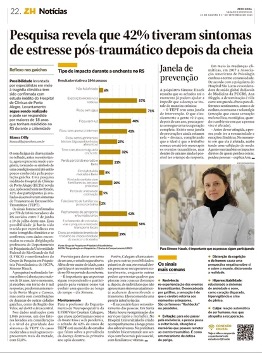
O laboratório levantou, em semanas, o impacto da enchente na saúde mental da população atingida e devolveu os resultados em tempo real — imprensa, poder público e serviços. A cobertura, na ordem em que saiu:
- Ansiedade, depressão, burnout e estresse: atingidos por enchentes no RS apresentam sintomas de transtornos, diz pesquisa
- Chuvas no RS: piora na saúde mental de pessoas de baixa renda aumenta
- Chuvas no RS: 90% dos gaúchos tiveram a saúde mental afetada
- Traumas coletivos: como nos apoiamos?
- Depois da enchente, pesquisa revela que 42% dos gaúchos entrevistados desenvolveram sintomas de transtorno de estresse pós-traumático
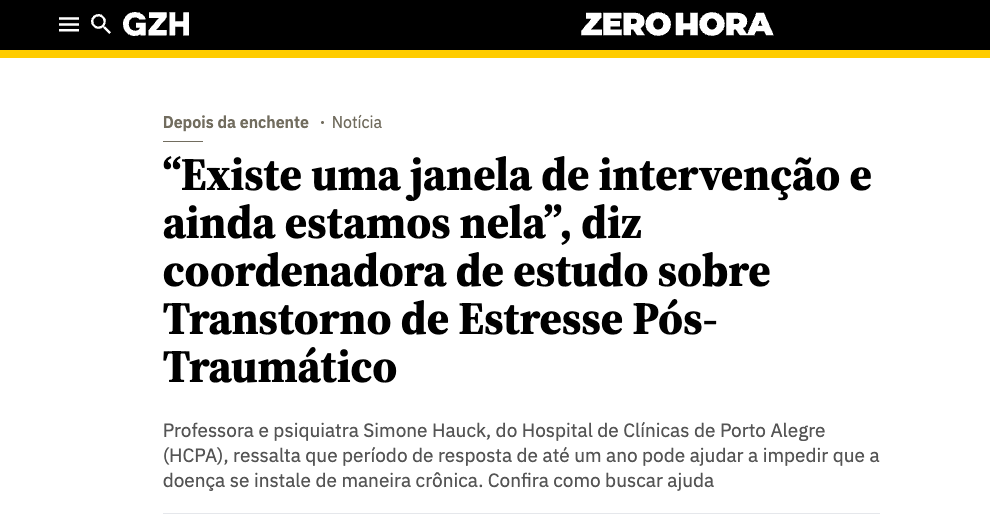
- "Existe uma janela de intervenção, e ainda estamos nela", diz coordenadora de estudo sobre transtorno de estresse pós-traumático
- Saiba como identificar os sinais do transtorno de estresse pós-traumático
- Pesquisa sobre saúde mental pós-enchente apresentada à Assembleia Legislativa
- How to recover when a climate disaster destroys your city
- Trauma após enchentes no RS ainda afeta gaúchos e preocupa profissionais de saúde
- Estresse pós-traumático desafia 1 em cada 4 gaúchos atingidos por enchentes no Rio Grande do Sul
PublicaçõesPublications
Seleção recente e raízes da linha. A produção completa está no Lattes e no Google Scholar, ao final. Recent selection and roots of the line. Full record on Lattes and Google Scholar, below.
Linha Atual 1: Fenótipos de Alto Custo de Processamento (HPCPh)Current Line 1: High Processing Cost Phenotypes (HPCPh)
- A topological architecture of neurodivergence: Transdiagnostic reframing of autism, ADHD, dyslexia, DCD, and high-ability profiles within the high processing cost phenotypes (HPCPh) frameworkacesso abertoopen access Hauck S, Terra de Oliveira L. Neuroscience and Biobehavioral Reviews, 2026;191:106992. doi:10.1016/j.neubiorev.2026.106992
- Burnout- and Depression-Like Functional Collapse States — A Within-Person Biomarker Framework for Precision Psychiatry: State-Dependent Multisystem Regulation in High Processing Cost Phenotypes (HPCPh)preprint Hauck S, Terra de Oliveira L. PsyArXiv, 2026 (versão 2). doi:10.31234/osf.io/qgam8_v2
- Extracellular matrix mechanics as an upstream organizing constraint in neurodivergent architectures: a hypothesis linking neural topology, volume transmission, and functional iron blockade Hauck S, Terra de Oliveira L. Medical Hypotheses, 2026;112009. doi:10.1016/j.mehy.2026.112009
- Functional iron blockade in chronic stress and neurodivergence: a perspective on adaptive stress physiology Hauck S. Frontiers in Psychiatry, 2025;16:1701625. doi:10.3389/fpsyt.2025.1701625
- Beyond overdiagnosis: reframing autism prevalence through a neurodivergent phenotype lens Hauck S, Terra de Oliveira L. Jornal de Pediatria, 2025;101(6):101467. doi:10.1016/j.jped.2025.101467
Linha Atual 2: Trajetórias de Recuperação | Quando Todos são AtingidosCurrent Line 2: Recovery Trajectories | When Everyone Is Hit
- Outpatient opioid dispensing during the 2024 floods in Southern Brazil: a population-based ecological time-series analysisacesso abertoopen access Frachia EF, Campiol JV, Diefenthaeler SM, Ornell F, Hauck S, Kapczinski F, Scherer JN. The Lancet Regional Health – Americas, 2026;64:101646. doi:10.1016/j.lana.2026.101646
- Brazil Diefenthaeler SM, Hartmann ML, Bassols AMS, Manfro GG, Hauck S. The Lancet Psychiatry, 2024;11(9):683. doi:10.1016/S2215-0366(24)00247-5
- Assessing mental health during an extreme weather event in southern Brazil Diefenthaeler SM, Cacilhas A, Hartmann ML, Prates-Baldez D, Hauck S. Trends in Psychiatry and Psychotherapy, 2025;47:e20240926. doi:10.47626/2237-6089-2024-0926
- Preliminary Report on Symptoms of Anxiety, Depression, and PTSD Following Severe Flooding in Brazil: A Longitudinal Perspective Diefenthaeler SM, Cacilhas A, Hauck S. Disaster Medicine and Public Health Preparedness, 2025;19:e189. doi:10.1017/dmp.2025.10125
- The Brazilian Personal Social Capital Scale 10 (brPSCS-10): A Translated and Adapted Version of the Personal Social Capital Scale 8 (PSCS-8) tested in a sample of residents of a flood-affected area Diefenthaeler SM, Marcon AC, Reginatto A, Hartmann ML, Cacilhas A, Prates-Baldez D, Hauck S. Revista Brasileira de Psiquiatria, 2026; publicação online antecipada. doi:10.47626/1516-4446-2025-4516
Burnout, ambiente de trabalho e dinâmica institucionalBurnout, work environment and institutional dynamics
- Psychometric properties of the Brazilian Portuguese version of the Copenhagen Burnout Inventory (CBI) in healthcare professionals Moser CM, Tietbohl-Santos B, Arenas DL, Xavier A, Ornell F, Borges RB, Gabbard GO, Laskoski PB, Hauck S. Trends in Psychiatry and Psychotherapy, 2023;45:e20210362.
- Beyond the Pandemic: Longitudinal Lessons on Social Support, Sleep Quality, and Burnout Among Healthcare Workers Moser CM, Tietbohl-Santos B, Laskoski PB, Hauck S. Journal of Occupational and Environmental Medicine, 2024;66(11):874–879. doi:10.1097/JOM.0000000000003194
- Mitigating burnout and suicidal ideation in the Brazilian health care workforce: the role of workplace support during COVID-19 Moser CM, Tietbohl-Santos B, Bassols AMS, Laskoski PB, Hauck S. Revista Brasileira de Medicina do Trabalho, 2025;22(4):e20241290.
- Work From Home or Bring Home the Work? Burnout and Procrastination in Brazilian Workers During the COVID-19 Pandemic Arenas DL, Viduani A, Bassols AMS, Hauck S. Journal of Occupational and Environmental Medicine, 2022;64(5):e333–e339.
- Psychiatric symptoms, burnout and associated factors in psychiatry residents Carneiro Monteiro GM, Marcon G, Gabbard GO, Baeza FLC, Hauck S. Trends in Psychiatry and Psychotherapy, 2021;43(3):207–216.
- Work Environment Evaluation Instrument (WEEI): development, validation, and association with burnout Carneiro Monteiro GM, Baeza FLC, Hauck S. Trends in Psychiatry and Psychotherapy, 2020;42(2):185–189.
- Institutional factors in the medical burnout epidemic Hauck S, Gabbard GO. Revista Brasileira de Psiquiatria, 2019;41(2):191–192.
- Mental health help-seeking among Brazilian medical students: Who suffers unassisted? Bastos TM, Bumaguin DB, Astolfi VR, Xavier AZ, Hoffmann MS, Ornell F, Spritzer DT, Bassols AMS, von Diemen L, Laskoski PB, Hauck S. International Journal of Social Psychiatry, 2022;68(6):1203–1212. doi:10.1177/00207640221082930
- Peer support intervention as a tool to address college students’ mental health amidst the COVID-19 pandemic Arenas DL, Viduani AC, Bassols AMS, Hauck S. International Journal of Social Psychiatry, 2021;67(3):301–302. doi:10.1177/0020764020954468
Raízes — trauma, marcadores biológicos e psicoterapiaRoots — trauma, biological markers and psychotherapy
- Serum brain-derived neurotrophic factor in patients with trauma psychopathology Hauck S, Kapczinski F, Roesler R, et al. Progress in Neuro-Psychopharmacology & Biological Psychiatry, 2010;34:459–462.
- Serum levels of brain-derived neurotrophic factor in acute and posttraumatic stress disorder: a case report study Hauck S, Gomes F, Silveira Júnior EM, Almeida E, Possa M, Ceitlin LHF. Revista Brasileira de Psiquiatria, 2009;31:48–51.
- Resilience to traumatic events related to urban violence and increased IL10 serum levels Teche SP, Rovaris DL, Aguiar BW, Hauck S, Vitola ES, Bau CHD, Freitas LH, Grevet EH. Psychiatry Research, 2017;250:136–140. doi:10.1016/j.psychres.2017.01.072
- Validity of the Epistemic Trust, Mistrust and Credulity Questionnaire and its correlation with personality traits and psychological distressvalidação BRBR validation Laskoski P, Detoni F, Vidor P, Souza C, Diefenthaler SM, Marcon AC, Rauffus D, Borges RB, Hauck S. Revista Brasileira de Psicoterapia, 2025;26:35.
Psicoterapia: Apego, Personalidade, Elaboração e SingularidadePsychotherapy: Attachment, Personality, Working-Through and Singularity
- Parental bonding and emotional response to trauma: a study of rape victims Hauck S, Schestatsky S, Terra L, Kruel L, Ceitlin LH. Psychotherapy Research, 2007;17(1):83–90. doi:10.1080/10503300600591209
- Confirmatory factor analysis of the Parental Bonding Instrument in a Brazilian female population Terra L, Hauck S, Schestatsky S, Fillipon AP, Sanchez P, Hirakata V, Ceitlin LH. Australian & New Zealand Journal of Psychiatry, 2009;43(4):348–354. doi:10.1080/00048670902721053
- Countertransference, Defense Mechanisms, and Vicarious Trauma in Work With Sexual Offenders Barros AJS, Teche SP, Padoan C, Laskoski P, Hauck S, Eizirik CL. Journal of the American Academy of Psychiatry and the Law, 2020;48(3):302–314. doi:10.29158/JAAPL.003925-20
- Association between different types of childhood trauma and parental bonding with antisocial traits in adulthood: A systematic review Schorr MT, Tietbohl-Santos B, de Oliveira LM, Terra L, de Borba Telles LE, Hauck S. Child Abuse & Neglect, 2020;107:104621. doi:10.1016/j.chiabu.2020.104621
- The association between reflective function and global functionality in patients with borderline personality disorder Bezerra GP, Laskoski PB, Terra L, Ramos-Lima LF, Serralta FB, Hauck S. Australasian Psychiatry, 2021;29(6):586–589. doi:10.1177/1039856220981801
- Machine-learning approaches in psychotherapy: a promising tool for advancing the understanding of the psychotherapeutic process Laskoski PB, Serralta FB, Passos IC, Hauck S. Revista Brasileira de Psiquiatria, 2019;41(6):568–569. doi:10.1590/1516-4446-2018-0295
LivrosBooks
- Psicologia Médica Aplicadaorganização Bassols AM, Passos IC, de Borba Telles LE, Hauck S (orgs.). 1ª ed. Porto Alegre: Artmed, 2025.
Capítulos de livroBook chapters
- The importance of psychoanalytic research to contemporary medicinecapítulo Hauck S. In: The importance of psychoanalytic research to contemporary medicine, 1ª ed. London: Routledge, 2020. v.1, p. 1–7.
- The key role of spirituality in positive psychiatry and psychologycapítulochapter Hauck S, Cloninger CR. In: Moreira-Almeida A, Mosqueiro B, Bhugra D (eds). Spirituality and Mental Health Across Cultures. Oxford University Press, 2022. p. 361–382.
- Trauma, Transtornos da Personalidade e TEAcapítulo 43 Hauck S. In: Riesgo RS, Gottfried C, Kapczinski F (orgs.). Tratado sobre o Transtorno do Espectro Autista, 1ª ed. Porto Alegre: Artmed, 2026. 896 p.